Here's a test of my readership: I need an actual opinion.
I pretty much assumed I'd want a separate GPS device, since they're a nearly foolproof way of grabbing your location no matter where you are. I didn't want to use my phone's GPS because it eats the batteries, and I hope to keep my phone fresh in case it's applicable in an emergency.
But here's the thing: an "outdoors" GPS is extremely expensive, like hundreds of dollars. Since I only plan on using GPS as a last resort, when maps, compass, and my own pretty reliable sense of direction aren't enough, is a unit worth it? Or would my phone be enough for rare and brief GPS usage? (There's an incredibly thorough GPS app for my smartphone, which contains 1. downloadable topo maps that are readable without a cell connection and 2. a nav system that communicates directly with satellites and is also operable without a cell connection).
I don't plan on bushwhacking; I'm sticking to marked National Park trails that are shown on topo maps and described in guidebooks. I'd probably use a GPS only if I accidentally ended up off the trail. And as I mentioned, I have a pretty good intuitive sense of direction, and I not only know how to read a map, but I actually enjoy cross-referencing my location with a map like every few minutes or so, even when I know where I am. So what's the advantage of a separate GPS? And is it 400 bucks' worth of advantage? If you've got more wilderness navigation experience than I do, please weigh in!
Wednesday, February 9, 2011


Monday, January 24, 2011
It's So Nice Out!
Today, January 24, in Yosemite National Park (where I plan to be about year from now), temperatures started out in the high 30s, and may reach the mid 60s at lower elevations.
Today, January 24, in Boston, Massachusetts, it's 4, which is so low it looks awkward to write in numerals. It's below zero where I grew up in Vermont.
Today is, I hope, colder than I'll ever bother with out west, but high Utah and mountain California might get pretty chilly. So I got my new long johns in the mail (the only ones at the store had little Christmas trees all over them; I just can't get behind that), put on my "nothin' at all!" pants, my new fleece, my wind jacket, and my Christmas sock-monkey hat (explain why I'll wear a monkey on my head but not trees on my underwear…) and donned my backpack to fetch 40 lbs of groceries for some hot, hearty meals. My experiment was to see whether the wind shell plus fleece and long undies would be adequate for winter, so I wouldn't have to spring for a (bulky, expensive, and non-versatile) heavy-duty winter jacket.
I was sweating. Having to do about 15 minutes of yoga just to climb into all that gear probably helped, too. But I didn't feel a thing. I was so immune to the weather that I actually made an excursion onto the middle of frozen-solid Spy Pond, about a half mile from my house. The only thing that would have made me more comfortable on the wind-swept ice was a pair of sunglasses.
I was ready for winter this year; we had a great, warm summer, and I'm still excited about the old-school ice and cold. When I was out today, the only other person on the bike path was a middle-aged woman. She gleefully kicked along snowballs and skated around on the icy spots. She rules. It seems like more than half of being comfortable in awful weather is deciding beforehand that it's fun.
Now to make stew!
Today, January 24, in Boston, Massachusetts, it's 4, which is so low it looks awkward to write in numerals. It's below zero where I grew up in Vermont.
Today is, I hope, colder than I'll ever bother with out west, but high Utah and mountain California might get pretty chilly. So I got my new long johns in the mail (the only ones at the store had little Christmas trees all over them; I just can't get behind that), put on my "nothin' at all!" pants, my new fleece, my wind jacket, and my Christmas sock-monkey hat (explain why I'll wear a monkey on my head but not trees on my underwear…) and donned my backpack to fetch 40 lbs of groceries for some hot, hearty meals. My experiment was to see whether the wind shell plus fleece and long undies would be adequate for winter, so I wouldn't have to spring for a (bulky, expensive, and non-versatile) heavy-duty winter jacket.
 |
| I can't put my arms down. |
 |
| Not pictured: Copious back sweat |
 |
| That whole walking-on-water thing isn't nearly as impressive up here. I did it for like 20 minutes. |
Now to make stew!
Sunday, January 23, 2011
Maptime
Hola. It's been a while since I rapped at ya'. We have piles of snow, plus the holidays and a sick cat and etc., and it makes me hibernatory. I've kept on prepping, a bit at a time. My generous friends Nick and Anna were awesome enough to ship me some wonderful hiking guides and maps to the Southwest. (They've relocated to the Pacific Northwest, where I hope to visit them.) I've researched stoves and dehydrated meals. I took advantage of end-of-winter sales to grab cold-weather gear on markdown, and got some fleece pants that can be described thusly:
(The "nothin' at all" part, not the "worst pain ever." Those would be bad pants.)
My next big step--and it's a critical one--is to set a start date. I have until October 5th, exactly, to get through the Pacific Northwest and Mountain West before I must be in Flagstaff, Arizona for the Grand Canyon rafting trip. Start too late, and I might miss out on things I want to see, or feel rushed and over-scheduled. Start too early and risk imposing on hosts, having to fill time, and missing my friends and our summer plans.
I bought detailed maps and guides to the PN and MW, intending to get a solid estimate of the time I'll need. Except the map for Olympic National Park is mysteriously absent from my bookshelf, and I can't recall whether Amazon overlooked it or I managed to lose it between the box and the bookshelf, so I guess wah. And the guide to Glacier is hard to follow, with weirdly whimsical maps and no organization of hikes according to difficulty or length, so eh. And the Grand Teton map was "temporarily out of stock" so guh. Oh, look, it's the Internet!
The specifics of this thing are starting to shift from really exciting to a bit scary. Stacks of Post-Its and wax pencils for my water-resistant maps help only a little in sifting through an overwhelming number of choices, and do absolutely nothing about the fact that I won't really know how long I want to spend in a place until I get there. It is very easy to get intimidated and decide to think about something else. (Is blogging considered procrastination?)
Here's something I did learn. Hikes in the North Cascades generally follow this description:
1. Drive 147 miles on an unimproved road to the trailhead.
2. Climb 2,900 feet in 1.8 miles.
3. Wow, mountains!
4. Turn around right away, because you had to drive 147 miles and then took like four hours to climb that measly 1.8 miles, so it'll be dark, like, now, and there's no camping allowed.
5. To get to the next trail, drive another 74 miles along an unimproved road to the trailhead. No facilities.
I'm not big into driving for hours before getting anywhere, or peak-bagging, or treeless scree, or turning around after just a couple of miles. I think North Cascades and surrounding preserves, despite their vastness, might only tempt me for a couple of days, as opposed to the near month I hope to spend in more accessible parks like Yellowstone.
On the other hand, these are some of the alternately hilarious and terrifying placenames in the North Cascades I might have to miss out on:
Joker Mountain
Elbow Basin
Tatoosh Buttes
Little and Big Beaver
Happy Panther Trail
Horse Heaven
Last Chance Point
Mount Torment
Mix-up Peak
Hurry-up Peak
Bugger Lake
Beaner Lake
Skookum Puss Mountain
Swede Heaven
Damnation Peak
Mount Despair
Nooksack Cirque
Egg Lake
Tmyhoi Peak
And speaking of Yellowstone: wilderness cred be damned, no way I'll miss those wooden walkways over the freaky rainbow pools no matter how crowded with pensioners, because supervolcano calderas are the shit, yo.
Thursday, December 16, 2010
If You're Not Part of the Solution, You Stay in the Filter
Though the Idiosyncratic Guidebooks boast the "clarity" of going without caffeine, sorry--not in the cards. Coffee is the world's most delicious addiction, and it just doesn't make sense to wean one's self off a warm, tasty, comforting stimulant just when you plan on doing a lot of trekking far from home. But coffee in the woods requires a strategy.
I refuse to do instant. It is not and does not taste like the real thing. Most regular coffee brewing systems are bulky or heavy or fragile or require electricity, and so are impossible outdoors. Lots of backpackers go for "cowboy coffee," hot water boiled right with the grounds, and then strained through some sort of improvisation, like a bandanna, or simply chewed. It's strong, but gritty and bitter, and almost demands that you carry sugar to take the edge off. (I don't normally put sugar in my coffee.)
The store-bought backpacking coffee kits promise amazing coffee through technical wizardry. Unfortunately, weight/bulk-wise, they don't give you much of an advantage over hauling your French press over the hills. They look like this:
And they cost like 40 bucks. Doesn't that seem like way too big a deal for pouring water over grounds? Isn't there anything lighter, simpler, lower-tech?
I tested my coffee solution this morning. This entire blog post is to let you know what a resourceful genius I am. Here's the secret formula:

+
Or, to put it another way:
I refuse to do instant. It is not and does not taste like the real thing. Most regular coffee brewing systems are bulky or heavy or fragile or require electricity, and so are impossible outdoors. Lots of backpackers go for "cowboy coffee," hot water boiled right with the grounds, and then strained through some sort of improvisation, like a bandanna, or simply chewed. It's strong, but gritty and bitter, and almost demands that you carry sugar to take the edge off. (I don't normally put sugar in my coffee.)
The store-bought backpacking coffee kits promise amazing coffee through technical wizardry. Unfortunately, weight/bulk-wise, they don't give you much of an advantage over hauling your French press over the hills. They look like this:
 |
| Ignition... and lift-off! p.s., Is that an antenna?? |
I tested my coffee solution this morning. This entire blog post is to let you know what a resourceful genius I am. Here's the secret formula:
 |
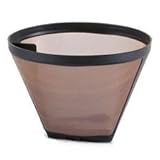
+
Or, to put it another way:
$4.99 + $6.99
Just add water. Well, water and coffee grounds and a mug. As a bonus, this is the only way the coffee ultrasnobs at the snooty place up the street make their drip cups: one at a time, with freshly boiled water drizzled slowly over the grounds. If done right, it makes an excellent, full-bodied cup--one of which I'm enjoying right now.
Coffee problem, PWNED.
Sunday, December 12, 2010
Progress Report
Big milestone, you guys. I'm halfway done preparing my dehydrated food! Want to see what three months' worth of food looks like?
Four shopping bags. That looks almost... sad.
But this is, in fact, happy news. When I first began dehydrating food, 180 dishes was an unimaginable amount. Filling the first shopping bag seemed to make a negligible dent in the total, and I despaired of ever having enough room to store the stuff, even in the nifty chest freezer I bought. And how would I ever get it where I'm going, and then carry it around with me? But fitting 6 months' worth of dinners into 8 neatly tied shopping bags seems totally doable. That wouldn't top off the trunk of a sedan, much less the bed of a pickup. It'll also make it easier to enlist someone to store the stuff and ship it to me in installments.
I'm very glad I bought the dehydrator and went the route of making my own meals.
 |
| It sounds like this. |
But this is, in fact, happy news. When I first began dehydrating food, 180 dishes was an unimaginable amount. Filling the first shopping bag seemed to make a negligible dent in the total, and I despaired of ever having enough room to store the stuff, even in the nifty chest freezer I bought. And how would I ever get it where I'm going, and then carry it around with me? But fitting 6 months' worth of dinners into 8 neatly tied shopping bags seems totally doable. That wouldn't top off the trunk of a sedan, much less the bed of a pickup. It'll also make it easier to enlist someone to store the stuff and ship it to me in installments.
I'm very glad I bought the dehydrator and went the route of making my own meals.
Monday, December 6, 2010
Goo Goo ga Choo
Even though it's currently mild in Moab, Utah, near where I plan to be a year from now, a bike ride in the cold and wind got me thinking about winter camping. (I'm also filling space on this blog, because there's not much going on right now.) As winter sets in, I'm trying to note how my body reacts to temperatures and conditions, to anticipate the cold-weather gear I'll want.
What I've observed is that I have the body of a walrus. This isn't about body dysmorphic disorder. Walruses live in the Arctic, and spend most of their time in the very cold water. A layer of blubber keeps them warm. Unlike other pinnipeds, they don't have thick fur as a final layer of insulation; instead, they have special skin. In the water, the blood vessels of a walrus's skin contract, drawing its warm blood down below the blubber layer. They look pale and clammy, like brining roasters.

But when they come out of the water and bask in the warm sun, their skin blood vessels dilate, and the blood rushes back to the surface, turning them pink.
I can be out in the cold for a really long time before my trunk or especially my legs feel cold--I've got a pretty well distributed layer of body fat, and I seem to radiate almost no heat from my skin. It's not unusual for my skin to feel truly corpse-cold to the touch after coming in from winter activities, yet I don't feel uncomfortable.
The huge exception to this is hands and feet. I sleep in wool socks. My fingers quickly numb. The lesson of the walrus is: invest in mittens and those warmy packets.
What I've observed is that I have the body of a walrus. This isn't about body dysmorphic disorder. Walruses live in the Arctic, and spend most of their time in the very cold water. A layer of blubber keeps them warm. Unlike other pinnipeds, they don't have thick fur as a final layer of insulation; instead, they have special skin. In the water, the blood vessels of a walrus's skin contract, drawing its warm blood down below the blubber layer. They look pale and clammy, like brining roasters.

But when they come out of the water and bask in the warm sun, their skin blood vessels dilate, and the blood rushes back to the surface, turning them pink.
 |
| Tyra says: Walrus brings it it H to T! |
The huge exception to this is hands and feet. I sleep in wool socks. My fingers quickly numb. The lesson of the walrus is: invest in mittens and those warmy packets.
Friday, December 3, 2010
Random Updates
Things, good and bad. Which first?
The bad: I somehow misplaced my backpacking cookbook, with all the dehydrateable recipes. This isn't too terrible: many of the recipes were sort of meh, I'm having great luck winging it, and the book is always available at the library.
The problem is that with the book went all my notes on how to un-meh the recipes. I bought a couple of key anti-meh ingredients (perishable ones) before I realized I'd misplaced the book. And I can't remember which vaguely Asian recipe was so improved by lemongrass, or which pasta dish tasted so surprisingly delightful with a handful of pomegranate seeds.
The good: I have a backpack! Hilton's Tent City finally called saying it was in. I picked it up, brought it home, and shoved the heaviest thing I had into it. It turns out that my new backpack is excellent at hauling around 22-lb. buckets of kitty litter. I'll have to test it on a long ramble sometime soon.
Intermediate news: I've acquired some apparel, including some good fleecy base-layer stuff, a nice wind shell, and a few other things. My dilemma is this: I sort of want to save all my expensive, fancy stuff so it's in pristine shape when I start, but some of it is just so damn nice that I can't resist the temptation to use it now. For instance, my wind shell (which is also good in light rain) is just too awesome for biking to keep stored in a closet. It's just so trim and toasty! And my fuzzy underlayers--hey, they're perfect for running in the cold! My worry is that I'll get them all funkynasty before I even leave. Some problem, right? My stuff is just too nice! Wah!
Friday, November 12, 2010
Invented Recipe 2
People I know who are better cooks than I already have food blogs, but I'm chowing on this right now, and it tastes so autumnal that I feel like sharing. And besides, will the above food blogs provide dehydratable/indefinitely storable recipes for the inevitable zombie apocalypse? I think not.
Butternut Squash Pasta
The butternut squash at the store were huge this week, so this method of preparing them two ways works well.
1 large butternut squash, divided into slightly unequal halves
1 lb small pasta
about 1 lb/4 links chicken sausage with apple
1 onion, minced
4 tbls olive oil
1 1/2 tsp brown sugar
1 tbls dried sage
1/2 cup heavy cream
1/2 cup grated Parmesan
Cut the smaller "half" of the squash, plus the sausage, into 1/2 inch cubes. Toss on a baking sheet with 2 tbls olive oil and the brown sugar, plus salt to season. Roast in a 375 oven until the squash is tender and beginning to caramelize, and the sausage is starting to crisp.
Cook and drain the pasta, preserving about 1 cup of liquid.
In a large saucepan or Dutch oven, saute the onion in the remaining 2 tbsp olive oil. Finely chop the larger "half" of the squash in a food processor, and add it to the onion. Add the pasta water, sage, and salt to taste, bring to a simmer, and cover. Simmer for about 20 minutes, or until the squash starts to fall apart.
Add the heavy cream and the Parmesan, and use a food processor or immersion blender to puree everything until it forms a smooth sauce. Add the pasta, sausage, and roasted squash, and toss everything to cover with the sauce.
I also added a bit of cayenne, but I didn't add quite enough to notice (I have pretty tolerant tastebuds), but I also don't miss it.
The food dehydrator usually takes about 6 hours to do a 4-serving meal like this. To rehydrate pasta dishes, most recipes call to just cover the dehydrated food with water, bring to a boil, and cook until the ingredients are as tender as you want them. This allows for one-pot, no-prep meals. I can imagine myself reanimating this particular recipe on a chilly evening somewhere in Utah and thinking of New England autumn.
Wednesday, November 10, 2010
... And You Spend a Night in the Box
I took the opportunity of a lingering coastal storm to test my tent and sleeping bag in the back yard. It was windy, rainy, and in the low 40s F, so chilly but not really cold.
Featherworm is awesome. I'm really glad I got the slightly heavier bag with the nifty features, rather than the super-elite ultra-light, because the features really make the thing. My favorite is a little extra flap that snaps closed around your shoulders, with a drawstring to cinch it. This keeps the bag closed and warm when it's cold enough to snuggle down, but not cold enough for the hood (and I don't like using the hoods--even when it's straight-up cold, I like having my face and ears free). And when it's a bit warmer, closing the snap-flap allows you to unzip the bag for a bit of ventilation without the bag flopping open and leaving you totally uncovered. The bag also has this little zip pocket near the opening that's so tiny that I can't imagine what I might put in there. It's too small for my glasses--the thing I really want to have safe and accessible while I sleep. Batteries? Nips? I'll think of something.
The tent, from a construction standpoint, did just fine. It was fairly windy, and rained quite a bit last night (though never particularly hard) and everything stayed in-place and dry. It was also a cinch to set up, even with the adjustments I had to make in the dark . . .
One of the selling points of the tent was that it has a convertible door on the rain fly. You can go with the vestibule if you need more room, or you can zip it out and exchange it for a flat door if you want to save weight. I was thinking the door was the way to go, since I'm only one person, and I'll have space to store stuff inside the tent. But the door isn't designed particularly well. It ends a couple inches from the ground, and it lies close over the tent wall--there's no way to stake it out, barring poking a hole in the fabric. So when it rains, water drips from the fly onto the wall of the tent below the door, where it eventually ends up dribbling between the tent and the footprint. While the bottom of the tent doesn't leak, this just doesn't seem like a good policy.
I set up the tent, with the flat door, in a break in the rain around dusk. I went out to sleep at my normal bedtime, at which point it was full-on raining. I saw what was going on with the door and switched it out with the vestibule. As with the rest of the tent, this was simple and intuitive and took all of like six seconds, during which I discovered the other slight design flaw with the door/vestibule system. The zipper to exchange the two runs up and over the door of the tent. The door of the tent is mesh. So if you unzip the thing while the rain fly is wet, drips will fall onto--and, of course, through--the mesh door of the tent, sprinkling your sleeping bag and clothes and whatever.
So I've learned a couple things. Vestibule is the way to go--and is a very nice place to put wet shoes, whether there's room in the tent or not. Also, tap all the drips off the rain fly before unzipping anything. Luckily, these issues seem easily solved.
 |
| With vestibule. Overexposure is for the protection of copyrighted logos. And 'cause I have a new camera app and don't know how to use it. |
The tent, from a construction standpoint, did just fine. It was fairly windy, and rained quite a bit last night (though never particularly hard) and everything stayed in-place and dry. It was also a cinch to set up, even with the adjustments I had to make in the dark . . .
 |
| Vestibule open. This morning, I realized the footprint was backwards, causing the wrinkling under the door. The tent is very slightly asymmetrical front-to-back; just enough so if you do it wrong, everything assembles just fine, but then doesn't quite work. |
I set up the tent, with the flat door, in a break in the rain around dusk. I went out to sleep at my normal bedtime, at which point it was full-on raining. I saw what was going on with the door and switched it out with the vestibule. As with the rest of the tent, this was simple and intuitive and took all of like six seconds, during which I discovered the other slight design flaw with the door/vestibule system. The zipper to exchange the two runs up and over the door of the tent. The door of the tent is mesh. So if you unzip the thing while the rain fly is wet, drips will fall onto--and, of course, through--the mesh door of the tent, sprinkling your sleeping bag and clothes and whatever.
So I've learned a couple things. Vestibule is the way to go--and is a very nice place to put wet shoes, whether there's room in the tent or not. Also, tap all the drips off the rain fly before unzipping anything. Luckily, these issues seem easily solved.
 | |
| My morning view. The November windstorm cleaned the trees before blowing offshore. |
 |
| WARNING: This is a pre-coffee photo. |
Sunday, November 7, 2010
Yes, Please!
A few days ago, I was mentally toying with the trip's schedule. I wondered if it might be better to switch the Southwest and the Colorado Plateau. I could avoid some really serious snow if I head straight for Yosemite after the Grand Canyon trip ends in October, and I'd spend January and February in Utah, where conditions are usually dry, if not mild.
But then I found this. The Ahwahnee Hotel hosts some culinary awesomeness in January and February, and it doesn't cost that much more than the luxury room I was hoping to splurge on anyway. They don't have a schedule for 2012 yet, but I'm willing to nail down a reservation once they do. It sounds like a totally delicious and fun break from camping! Plus it will give me an excuse to pack at least one gala-worthy outfit.
And: I know this is totally ridiculous, but I've named my sleeping bag. Its (his? what gender would a woman's sleeping bag be?) full name is Weatherfirm Featherworm, but I pretty much go with Featherworm for short.
And: I am a nerd.
Subscribe to:
Posts (Atom)