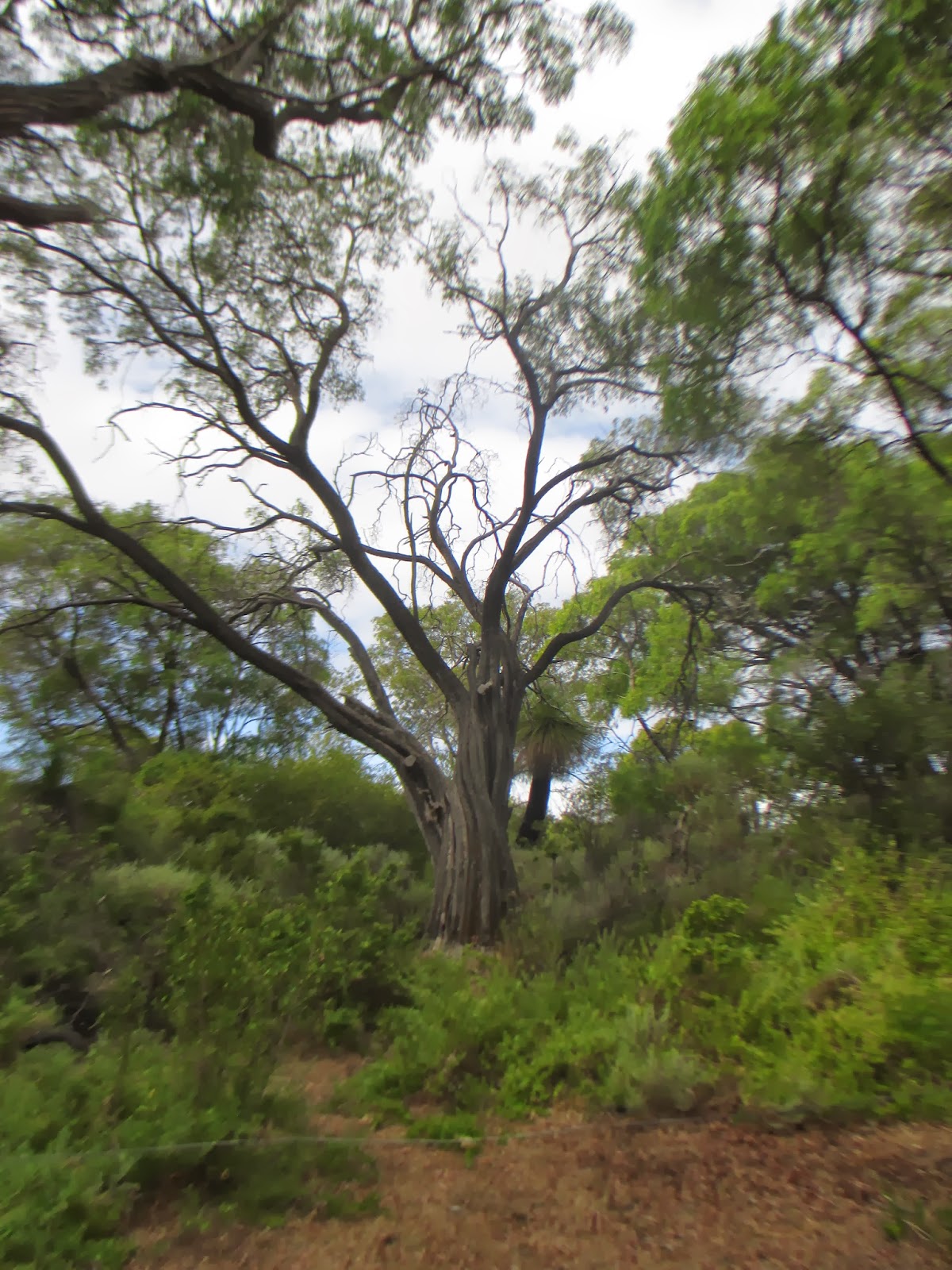
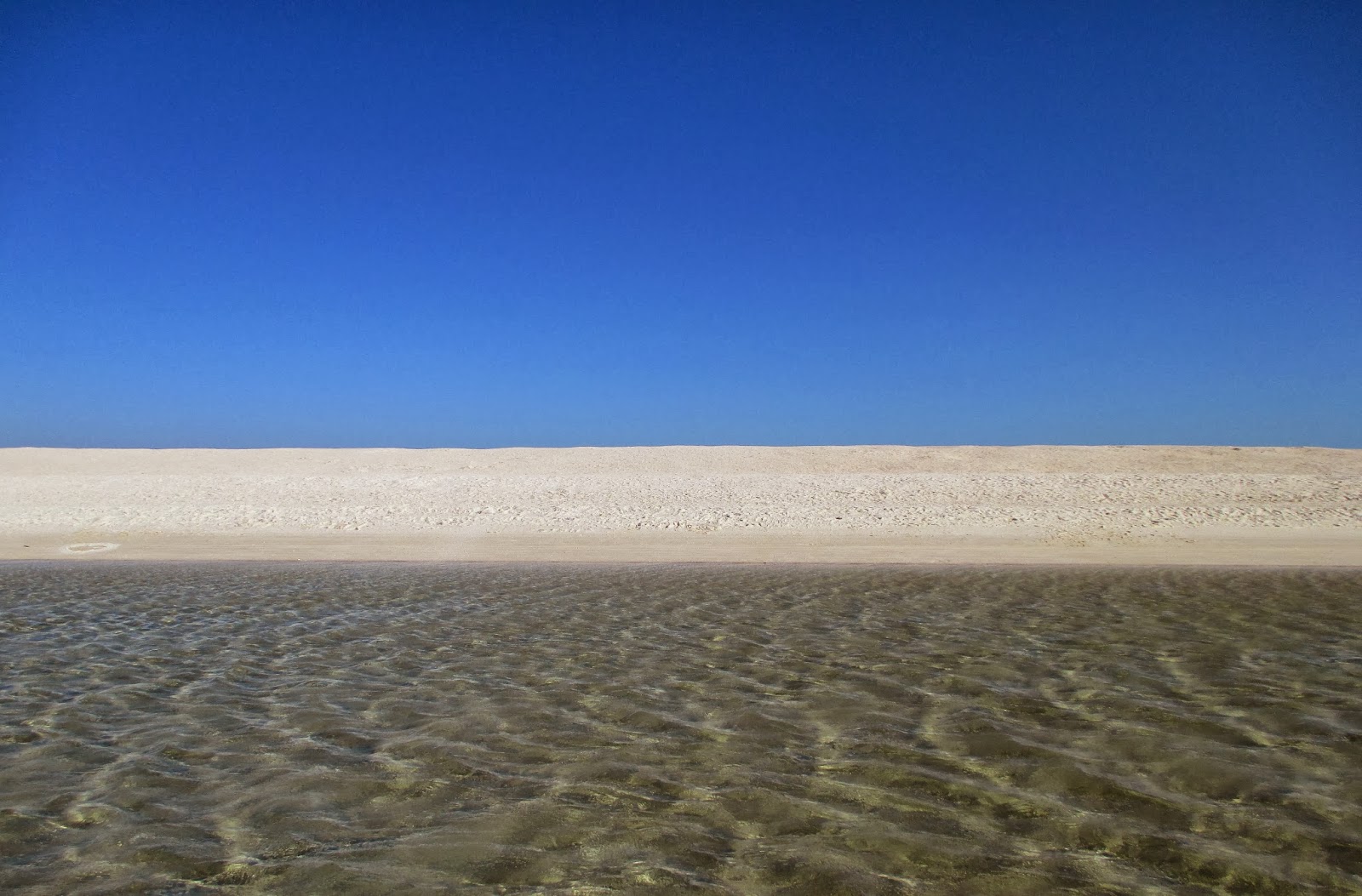
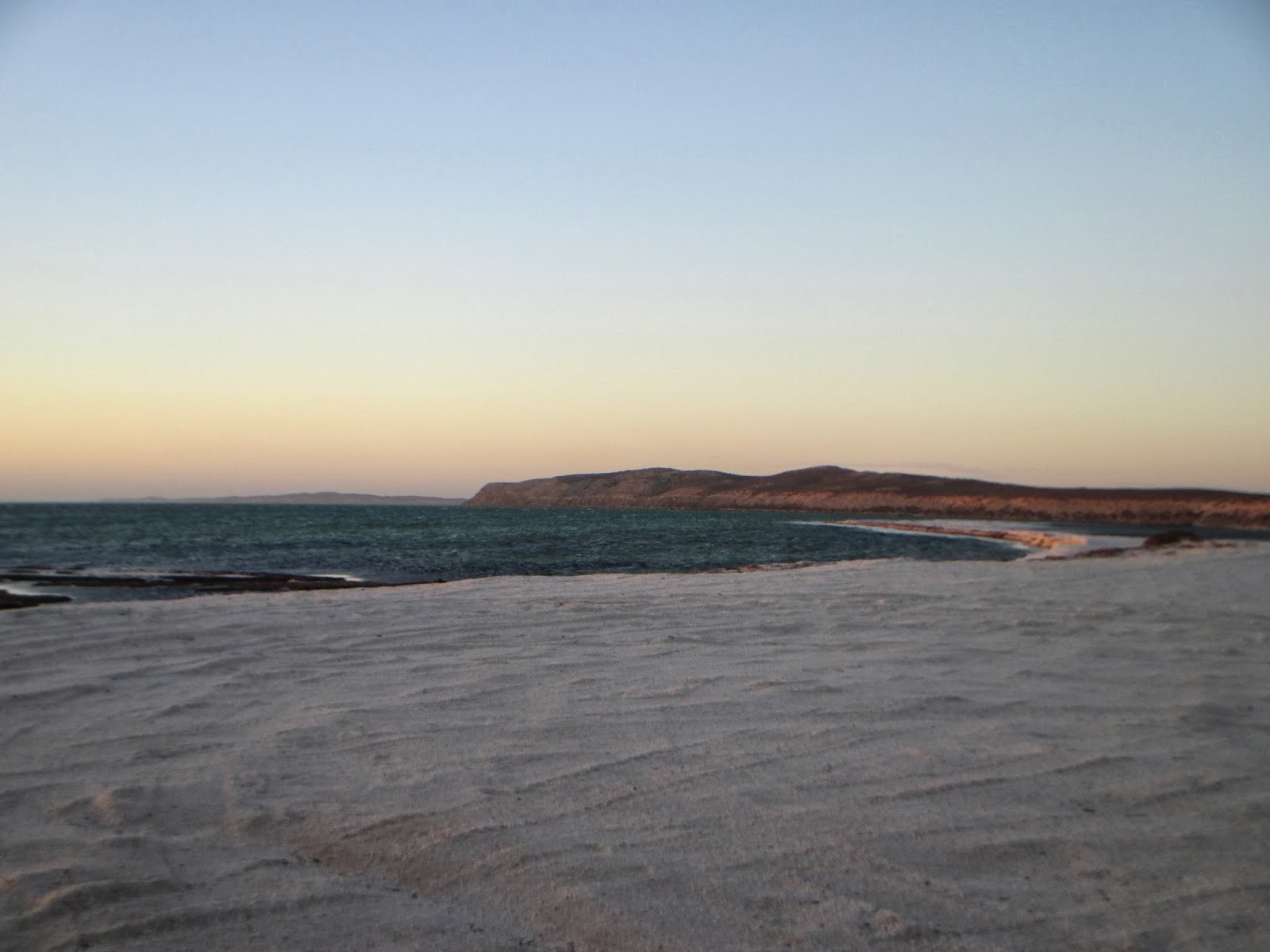
Thursday, March 13, 2014

The Biggest Tingle

Tingle trees are some of the tallest trees in the world. Think of the pun-sabilities! Australia did. I passed more mildly dirty "Tingle-" themed motels, gift shops, and art galleries than you want to know about.

Where the Australian coast hangs a right and turns from the Indian Ocean to the Southern Ocean, the cool, moist climate supports some of the tallest trees in the world. Karri trees are an exceptionally beautiful form of eucalyptus with blond, barkless trunks and a graceful, soaring shape. Tingle trees are also eucalypts, but they keep their bark and look like elegant old maples, only much larger.

While redwoods may be taller and much more massive, they can't compare with the prettiness of a karri forest. I took several scenic drives and spent two nights camping in a caravan park in Walpole-Noralup National Park, home of the treetop walk and a few other forest features.

A karri grove
They shed their bark in piles on the ground
A naked trunk
In one of the tallest groves, the park built a massive suspended pathway about 100 feet above the ground, passing between the branches. I went early in the morning, and it was peaceful and lovely.


The flowers hummed with bees.
On a drive around the countryside (rather dry, like California in the summertime, and spotted with cows and sheep), I spotted signs for a "scenic walk," and pulled in to stretch my legs. A map noted a "climbing tree" called the Bicentennial Tree. It wasn't in any of the guidebooks or on any other advertising, but I decided to check it out.

The blur makes it seem extra scary, right?


The tree is well over 200 feet tall. They've drilled rebar into the trunk to form a giant spiral ladder that climbs all the way up to the canopy. The top platform is actually 3 platforms, each connected to the next by a ladder.

I got out of the car, took one look up, and said to myself, "Oh yeah, I'm climbing up that whole thing!"

From the first platform, only about a third of the way up

Above the canopy


The climb was tough and vertiginous--there was netting along the sides, but nothing between the "rungs," some of which were plenty far apart enough to slip through. But the platform at the top was wonderful. It was roofed and shady, and a gentle breeze came in from the coast. I could have slept there. Plus, I was the only one at the top. On my way back down, I met a retired British vacationer who used to rock climb. He also relished the adventure, and we agreed that it was the highlight of the park. I can't imagine it existing in the US.

I'm now at a hotel in the beach-resort town of Esperance, preparing for a 2-day solid slog across the treeless, uninhabited expanse of the Nullarbor Plain. It might be some of the most remote traveling of this trip, but luckily, it's the only road around, and there should be plenty of other caravaners. I'll be landing in another park in South Australia, so it'll be a few days before I can update again. Check ya later!

The Western Capes

The state of Western Australia takes up nearly half the country. It's as if everything west of the Continental Divide were one big state, only with fewer than 1/3 the people. Perth and the north are the driest part. Heading south, things become much more pleasantly Mediterranean.

Possibly the most traditionally pretty area of Western Australia is the Margaret River Valley and the capes of the southwest coast. The Margaret River is wine country, and a national park hugs the dramatic coastline. Since there are other wine regions in Australia, and I was eager to get away from tourist havens and civilization, I stuck to the national parks. I spent a couple of nights camping in a forested area near the sea. Even from behind a ridge line, you could hear the pounding ocean. The waves were enormous. No swimming here.

Also, it turns out that my blurry photos aren't from anything I'm doing wrong. My camera keeps giving me a lens error, which may be from grit finding its way into the mechanics. It's likely the cause of the bad shots, and it's not really fixable. For snapshots, it's still okay, but for keepsake photos, it's poo.

The beaches here are not effing around.


I camped in a little wooded glen with some really oddball plants in the forests all around.


That night, a little possum (not the hideous American kind; the cute Australian kind) climbed down the tree by my tent and visited me. I awoke to MASSIVELY LOUD kookaburras hollering right above me, and then I spotted a mother and joey kangaroo browsing contentedly near my tent.

I don't know how else to say it, but all the marsupials I've met have seemed a little... senile. They never react to people as a threat, even though native Australians have been murdering them for 40,000 years. They're incredibly docile, and none of them even flinched at my blazing headlamp shining in their faces. Plus, they all seem to have prehensile tails--kangaroos use them as tripods--and prehensile tails creep me out for some reason.

But Australia's got a coastline. It's pretty nice.


Wednesday, March 12, 2014

Into the Rat's Nest

I was having a nice life-maintenance day in Perth's trendy suburb of Fremantle when I came to the realization, even while sitting in a lovely café, that I’m ready to move on from Perth and the West Coast. It’s time to get this journey moving on its counter-clockwise push. But first, I had an essential day-trip to take.

The quokka has been dubbed the “happiest animal in the world” by Buzzfeed, who, hyperbole aside, knows its adorable critters. The only place in the world where quokkas live is Rottnest Island, a short ferry-hop from the Fremantle pier. In fact, “Rottnest” is Dutch for “Rat’s Nest,” because they mistook the little buggers for giant rats.

I was apprehensive on the ferry ride over. The wildlife experiences I looked forward to in Shark Bay turned out to be awfully touristy, and the ferry crowd threatened more of the same. As soon as we landed, I unloaded my trusty cheapo hybrid and took off for the island’s uninhabited West End, hoping to get away from the settlements and the crowds. But I wasn’t sure about my chances. Would I even spot a single one of these small, modest, nocturnal animals?

Not 500 yards from the pier, I saw my first quokka, right by the side of the road. 

Hi!
About 10 minutes later, there was another, skittering into the bushes. Then, I spotted one taking some shade under a roadside picnic bench. I parked my bike on the road, keeping my distance so as not to spook it. Then, this happened.

eeeeee!

eeeeeeeeeeeeee!!

EEEEEEE!!!

EEEEEEEEEEEEEEEEEEEEE!!!!!!!!
  
“Inquisitive little fellars, aren’t they?” Another visitor remarked while his wife took photos of them crowding around her feet. ("There are heaps of them!" she shouted.) I don’t know how inquisitive they are, or, honestly, how bright. I think people feed them. And I don’t care. I touched one. I TOUCHED ONE. 

Unfortunately, they don't have the permanent "happy face" Buzzfeed sells you. They have your typical, albeit sweet, marsupial face. And they do have really ratty tails. But their stupid little ears and absolutely snuggly demeanor more than make up for it.

Rottnest has just one tiny settlement near its pier, and then nothing but windswept heath and sheltered coves for swimming, snorkeling, and fishing. I took a leisurely route home, stopping on deserted beach after deserted beach. 


 The summer heat has finally broken, and it was cloudy and too chilly for swimming, so I would either walk on the sand or just wade out. Standing knee-deep on an utterly deserted beach, I was startled by an American accented voice behind me, saying, “If you’re going in that far, you might as well just jump in!”

It was a nice young Canadian guy I’d noticed making a similarly speedy bike loop around the island. His name was Andrew, and he’d been living in Australia for a year, alternately working in the gold mines and traveling. We hit it off right away, and continued on our bike tour together, catching lunch at the one pub in town. While we were eating on the patio (having a conversation about what animals we would take on in a cage match--he wanted to fight an ostrich, and I'd take on a panda any day of the week), a quokka came up and started begging chips from the patrons right on the deck. So I was right about them being fed. Meanwhile, the sun had come out, and the day had warmed up enough for us to get in a quick swim before catching the ferry ride home.

It was an excellent last day in Perth. I've since traveled around the "corner" of Western Australia to head east, across the vast coast of the Southern Ocean. I have a lot of updates and photos to share, but it's mostly been camping, so I've been without internet. Look for more updates soon!
 

Friday, March 7, 2014

First Road Trip

I finally put the vehicle to good use, and made a 4-day trip up the West Coast to Shark Bay.

I'm thinking of naming it "Princess."
Shark bay was a major motivator for this trip. It's got abundant wildlife, beautiful scenery, and the few living examples of stromatolites, the very earliest life-forms on earth. Unfortunately, I was a bit disappointed overall.

I expected to drive long distances to get places in Australia; the guidebooks give you ample warning, and the scale is easy to grasp when you realize that the country is about the size of the continental United States. What I didn’t expect was that when I got to a place, everything in that place would still be ridiculously far apart. Shark bay is nearly 200 km long. With a 100km/hr speed limit, that means two hours from top to bottom. With one major tourist site on the south end, and the other all the way at the north, and the only fuel and food about halfway in between, not to mention well-spaced campsites, you can easily eat up three or four hours a day just getting from place to place. And the scenery in between stops isn’t much to look at. 

The only time the view changes is when new bugs hit the windshield.
The moment I ever stepped out of the vehicle for a roadhouse break, I was immediately assaulted by two things: the overwhelming heat, and truly maddening swarms of flies. The flies here are legendary, and as unavoidable as the weather. There are so many surrounding you at once that the buzz swells into an overwhelming chord. The locals don't even bother waving them away anymore, though they'll take a chomp if you let them settle on you for long. Also, the sun was brutal, especially for my February-pale skin. It takes me almost as long to prepare to go out in the sun here as it does to prepare to go out in the blowing snow on the ski slopes of Vermont.

I did get lucky with my campsites. They were right on the coast, and buffeted by constant, powerful winds. While the wind made camping a bit difficult (and was so strong that it made my photos come out blurry), it was preferable to heat and flies. The permits were one night only, but when I requested another for a second night, the woman at the office waved it off and said, “Well, I’m not supposed to…”

The first night, I was on a small, isolated cove.


The second was an unbelievable wide-open beach, with a long lagoon behind a high sandbar made of billions of tiny white shells. I waded in the warm lagoon (careful to keep my toe-shoes on, as the guidebooks warn of poisonous stonefish), accompanied by sting rays and some kind of shark or skate with salmon-pink fins. When I went to explore a shady area of green shrubbery, I startled a big red kangaroo, who bounded away. There were several hopping about, especially early in the morning.

Spot Princess at the center, far off. The beach was about a mile long, and deserted.


You can kinda see the sharks here. The water was crystal-clear.


Wobbly sunset over the Indian Ocean
 That's the good part. The bad parts involved getting there, getting food, getting fuel, and seeing the stromatolites. Stromatolites are intellectually interesting, but really, they look like blobs of crap.

Thanks for oxygenating the atmosphere, blobs of crap!
The bay where they live is a hellhole of searing heat, with blizzards of flies. I got out of the van, walked down the boardwalk, took a photo (blurry in my frantic fly-waving), and got right back in my car and left.

Another okay part was Shell Beach, which is just what it sounds like: a beach made entirely of tiny white shells. While it wasn't swarmed with flies, it was nonetheless deserted, and not particularly welcoming. It turned out that the beach at my second campsite was also all shells. Nowhere did they ever tell you where all of these frikking shells come from, which seems like the obvious question.

All shells. No sand.


The other disappointment was Monkey Mia, the resort at the tip of Shark Bay, which was supposed to be a wildlife mecca. When I arrived, I was dismayed that it really was just a resort, rather than a national park or nature reserve. There were cabins and shoddy restaurants and tourist posters everywhere, all accompanied by more choking heat and infuriating flies. The only entertaining thing about the place was that they have pest emus.
doi.
Do you know why they call it Monkey Mia? Oh. Me neither.

So after a quick lunch, I high-tailed it back to my nice campsites. So Shark Bay amounted to hours and hours of driving, followed by two nice campsites, and that was it.

My other major disappointment was that I had yet to swim in the wonderfully warm Indian Ocean. Most of the waters in Shark Bay are so dramatically shallow that you can wade out until you get bored and still not reach bathtub depth. The water also supports miles of sea-grass beds, which are excellent for sea life but kind of squicky to swim in. The one really beautiful aquamarine ocean, at Monkey Mia, is a protected “Dolphin experience” area where you’re not supposed to go in over your knees.

Right now, I'm back south in Fremantle, Perth's cool coastal suburb, and I'm happy to say I solved my final problem. Even though South Beach in Fremantle is considered "Not worth a special trip" by local internet reviewers, it is by far the best beach I've ever been to. Today I spent a few hours happily bobbing in its calm, crystal-clear, aquamarine, cool-shower-temperature waters. Heaven.

Second Impressions of Australia:
  • A lot of people swim in hats. Considering that the average Australian looks like an Irish person who's been squinting for his entire life, they justifiably take the sun seriously.
  • They really know their refreshing beverages: anything with lemon, lime, or ginger is top-notch. They can’t seem to fathom iced coffee, though. The only iced-coffee beverages I’ve found were actually more like coffee-flavored milk—whole milk. And lord knows, when you’re hot and parched, there’s nothing you want more than a half-litre of thick, creamy, sweet whole milk!  
  • Speaking of coffee: The coffee in Australia is universally excellent. It isn’t surprising that you can get really good coffee here—you can find really good coffee in any Western country. What’s surprising is that you can’t get bad coffee here. There simply is no diner dishwater, no scorched 7-11 swill, no Dunkin’. You can walk into the most unlikely tourist restaurant in the most depopulated resort town and receive a coffee that’s as fresh and expertly prepared as the snootiest barista-haven in Cambridge. Honestly, though, I’d accept a small drop in quality for a bit of an increase in quantity; the roadhouses are often bereft.
  • They’ve opted out of the highway-driving-as-blood-sport. Australians on the freeway are like,
    “I enjoy going the speed limit!”
    “You don’t say—I enjoy going the speed limit, too!”
    “How about we each take our own lane, and we’ll go the speed limit together!”
    “Hooray!”
  • Australians are extraordinarily friendly. This is different from “polite” or “professional.” They assume an easy, dirty-language familiarity right away. Introducing the “No Shirt, No Shoes, No Service” sign would devastate the Australian economy.  
  • The aesthetic here is very healthy, very blonde, very mainstream, for lack of a better word. I went outside one evening with my glasses on and realized I was the only person wearing dark-rimmed hipster frames. Over tea, I chatted with the Perth AirBnB owner about a recent New York Times article declaring Perth the latest “hipster” capital, mostly due to its bar scene and locavore restaurants. “It said we’re the new Brooklyn. Is that true?” he asked. Well, I had to inform him, you'd never see people in Perth riding those old-timey bicycles with the big giant front wheel and the little tiny back wheel, so no. It isn't a "hipster" town in the way I'm used to thinking of. There’s very little of an “alternative” or  “ironic” culture here. That’s somewhat uncomfortable for me, because for most of my life I've aimed for an edgy or counter-mainstream aesthetic, so I feel like I stand out a bit.  It’s also a relief, because everything is sincere and straight-up, with no undercurrent of sarcasm or arch self-awareness. 
  • The crows here look just like American crows, but they sound just like "the goat that yells like a man."
  • People here lock up their bikes with cable locks. And they lock just the frame. What. Boston, you know what I'm talking about.

Saturday, March 1, 2014

Opposite Land!

Hello from Australia! I'm in my lovely room in Perth via AirBnB. It's about 100 degrees out, and I've just retreated from the blazing antipodean sun for the afternoon.

Not Very Opposite-y
Bill Bryson observed that it was happily disconcerting to fly all the way around the world, only to end up in a place that feels profoundly familiar, and he's right. The only way you can tell Perth isn't an especially nice part of San Diego is that there are no Mexicans. (I don't mean to be flip: a fish taco and a frozen margarita would compliment this place most excellently.) The sun is crisp, the streets are wide, the cars are new and clean, and everyone is relaxed and tanned. The only way I stand out is having skin the color of boiled Irish cabbage.
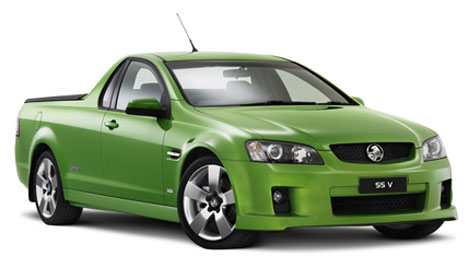
So far, most of my time has been taken up with errands. I picked up my advertisement-festooned campervan and drove its giant, roaring bulk across town (staying dutifully on the left), and then promptly went out and bought a cheap hybrid bicycle that suits the small city much better. I haven't seen much of the country yet, and sadly, no pictures. This evening, I plan to step out for my first bit of recreation, and I'll bring my camera. But:

First Impressions
  • You know how old ladies dress in cartoons? Starchy floral dresses, cardigans, knee socks, and orthopedic shoes? American old ladies wear, like, track suits. But Australian old ladies dress like "Old Ladies." It's comforting.
  • The women here wear really excellent shoes. I was under the impression that people lived in flip-flops, but I'mma have to step up my footwear game.
  • My guesthouse is near Perth's Chinatown, but it's the most clean, organized Chinatown I've ever been in. I saw a guy pushing what looked like a bagger lawnmower along the sidewalk. It was a vacuum cleaner. Carol Follett would be proud.
  • A lot of people drive these sweet El Camino looking things and I totally want one.


  • Despite looking and feeling like SoCal, there's a strong pedestrian presence in the city's downtown. I spent nearly an hour getting hopelessly lost in a maze of plazas and malls looking for the stupid cell-phone store, and it was a constant crowd. Unfortunately, most of the walking areas are shopping malls, so despite the good people-watching, the cultural offerings are a bit bland.
  • Everything is very functional. Whenever I've needed something, the people who helped me were friendly and knowledgeable. In fact, the only problems I've had with my arrival have come from 1. Fucking Verizon and 2. Fucking Bank of America.
  • Even though it's summertime, Australia is so much closer to the equator than the US that the sun sets relatively early--7:30ish. 
  • Because so many of the trees are varieties of eucalyptus, the whole place smells as though it's been gently deodorized. 
  • I've seen only a couple of things that are unmistakably Australian: a few rainbow lorikeets,

  • This doesn't seem like the kind of thing you should be able to see on a city bike path.
    • and the occasional Aboriginal Australian. I'd heard that Aborigines were often pretty down-and-out, and while they do make up a decent part of the homeless population, most of the native people I've seen have dressed and appeared just like other Australians, which is nice.
    But how was your flight!?!
    Long. Emirates is pretty swanky; the food was universally tasty, and the selection of movies, music, and info on the seat-screens was great. (I enjoyed dozing off to the soothing image of clouds passing underneath us via a live camera feed from beneath the aircraft.) However, the best part of the flight was something the airline had no control over: on one of my longest nighttime legs, I had an entire 3-seat row all to myself, so I could lie across the seats and sleep.

    Monday, February 24, 2014

    The Equivalent Australian Opposite of "G'Day!"

    Tomorrow is launch day! I'll be in a netherworld of jet lag and time-zone differences from Tuesday until Thursday evening, local time. Since several people have asked for a map, here's the outline I put up a few months back:


    View Larger Map 

    Click the link under "view larger map" to see what the lettered points are. My main plan hasn't changed much since I made this. In fact, the only official reservations I've made are the flight in and out and a 4-day acclimation stay in Perth.

    Today, my main errand is to drop off Sindri at the boarder's. I like to imagine that when my cat is "going to the boarder's," he's really going to a chain bookstore where nerds will let him sit on their laps while they read comics, and where maybe someone will sneak him a slug of whipped cream now and then from the on-site Starbucks.

    See you when it's summer!

    Wednesday, January 29, 2014

    Let's Not Get Crazy

    Now that I'm just one month out, I'm starting to gather all my stuff and think about how to pack. I still have all my super-sophisticated backpacking gear from previous travels, and it's way more fun than it should be to spread everything out on the floor and decide what I'll need and what I won't.

    However, my hyper-preparedness for my last trip has made me paranoid. Because I have so much wilderness gear, it's tempting to pack as though I'm going to blast into the outback by myself for two months straight.

    I keep having to remind myself: Australia is a civilized country! They sell food there! They have giant camping stores! One of their nationwide banks has a deal with my nationwide bank so I won't even pay ATM fees!

    Seriously. This is a driving trek, not a hiking trek; at most, I plan to spend 5 or 6 (non-consecutive) nights out of two months camping away from my vehicle.

    Also, summer clothing is much, much smaller than winter clothing. I'm happily realizing that I'll need to carry fewer bags than I planned. I just have to make sure there's room to bring home koalas wine.

    Wednesday, December 4, 2013

    Damn, Nature, You Scary

    Australia is home to deadly, deadly things. The deadliest snakes, spiders, reptiles, fish, birds, and probably fluffy bunny rabbits live here. Here's a quick survey of the things I'm afraid of in Australia, on a fear scale from 1 to 10.

    1: Snakes. Yes, Australia has the deadliest snakes in the world, including sea snakes, but on the whole, I don't think of snakes as that dangerous. I've never been bitten by a snake. Nor has anyone I know. I kind of like snakes, and from all experience, they tend to be sedate or even timid if you leave them alone. So while snake venom may be terrible, you have to get it in your bloodstream for bad things to happen, and that seems unlikely. 

    2: Spiders. There are tons of venomous spiders in Australia, including one that focuses itself in and around Sydney. I kind of feel the same way about spiders as I do about snakes: in opposition to the popular opinion, I have a certain affection for them. Unlike snakes, though, I can certainly see how someone could overlook a spider and accidentally get bitten.

    The redback, clearly a relative of the US black widow. I lived with black widows in Tucson without a problem.
    2.5: Drop Bears. Google that stuff. 

    2.5 Cassowaries. Like other big, dangerous animals, encounters with these guys are rare, but the cassowary is reported to be aggressive and potentially dangerous if it feels threatened. Like other big, dangerous, animals, I'd love to see one. But from a distance. Those things are dinosaurs.
    3.5–4: Sharks. I plan on being in the water a lot, but sharks are rare, and shark attacks are rarer, and many beaches in Australia are patrolled.

     5: Crocodiles. This is where things turn from "Not really something I'm going to bother thinking about," to "Yeah, no." Saltwater crocodiles are big, charismatic, and fascinating. I'd love to see one, but in a controlled environment, like a croc farm. They're one of the few animals that routinely stalk and kill humans, and they do it much more often (and much better) than other maneaters. Guidebooks note that when camping in croc territory, it's best not to fetch water from the same spot more than once. Which is extra scary, because it means they're watching you.
     
    Keeping the food chain in order.


    6.5: Reef Residents: Stonefish, Blue-Ringed Octopus. You can see why people get stung by picking up the delicate, lovely blue-ringed octopus. Don't you just want to make a necklace out of it?
    A necklace made of death within minutes.
     8–10: Jellyfish. Brainless, floating shopping bags with tentacles that sting you just by touching you. You can even get stung if you brush against stray shreds of tentacles that aren't attached to the animal anymore. Some, like the box jellyfish, are deadly. Others will just make you wish for death, what with the crippling, full-body pain for up to a week. The problem with jellyfish is that they have no real behavior to speak of. You can't avoid them by being conscientious or out-thinking them or even avoiding their specific homes. They just float there, in the middle of open water, all like "DUHHHH," and if it floats near you, you're dead.